If you have been told you need a root canal, your first reaction might be one of anxiety. For decades, root canals have been the subject of dental urban legends, often unfairly associated with pain. However, modern endodontic technology has transformed this procedure into a routine, comfortable treatment that is no more invasive than getting a deep filling.
At Monteluz Dental Specialty Group, we believe that understanding the process is the best way to alleviate dental anxiety. By knowing exactly what to expect during your visit to our San Bernardino office, you can approach your appointment with confidence and peace of mind.
What is a Root Canal?
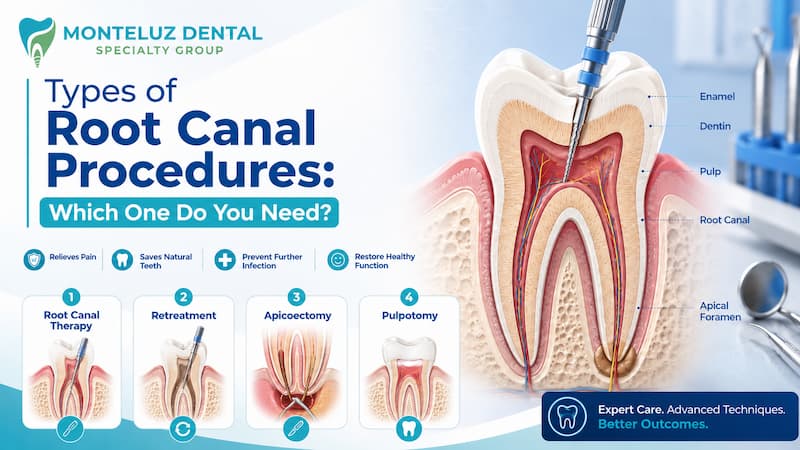
A root canal, or endodontic therapy, is a procedure designed to save a tooth that is severely decayed, infected, or damaged. Inside every tooth, beneath the white enamel and the hard layer of dentin, is a soft tissue called the pulp. This pulp contains blood vessels, nerves, and connective tissue that help the tooth grow during development.
Once a tooth is fully mature, it can survive without the pulp because it continues to be nourished by the tissues surrounding it. A root canal is necessary when the pulp becomes inflamed or infected due to deep decay, repeated dental procedures, or a crack or chip in the tooth.
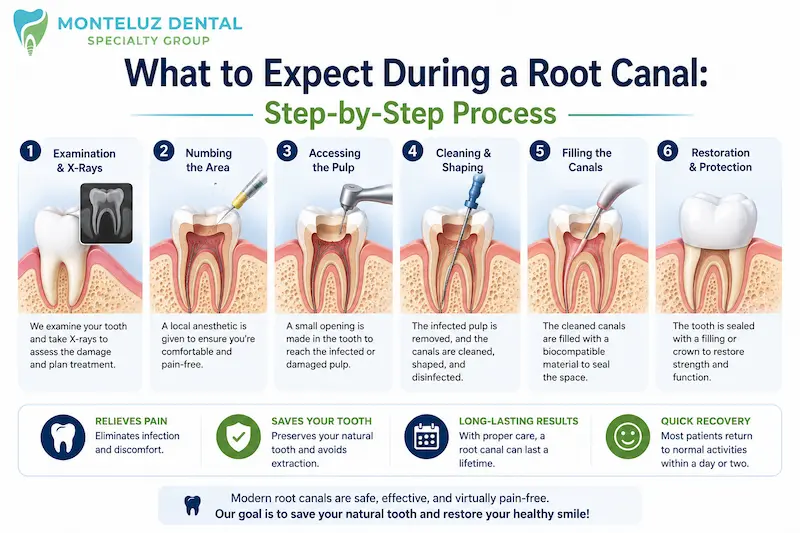
Step 1: The Initial Consultation and X-rays
The process begins with a comprehensive examination and a series of digital X-rays. Because Monteluz is a specialty practice serving the Inland Empire, we utilize advanced imaging to see the precise shape of the root canals and determine if there are any signs of infection in the surrounding bone.
During this stage, your endodontist will:
- Evaluate your symptoms (such as temperature sensitivity or persistent pain).
- Review your medical history.
- Discuss sedation options if you are particularly nervous.
- Explain the findings of the X-ray and how the procedure will proceed.
Step 2: Numbing and Preparation
Before any work begins, the dental team will ensure you are completely comfortable. This starts with the application of a local anesthetic to numb the tooth and the surrounding gums. You may feel a slight pinch during the injection, but once the area is numb, you should not feel any pain during the procedure—only a bit of pressure.
Once you are sufficiently numb, a small protective sheet called a "dental dam" is placed around the tooth. This isolates the tooth, keeping it clean and dry from saliva during the treatment. It also prevents any debris or cleaning solutions from entering your throat.
Step 3: Accessing the Pulp
With the area prepared, the dentist makes a small opening in the crown (the top) of the tooth. This provides access to the pulp chamber and the root canals. Using specialized, high-precision instruments, the dentist begins to remove the diseased or dead pulp tissue from within the tooth.
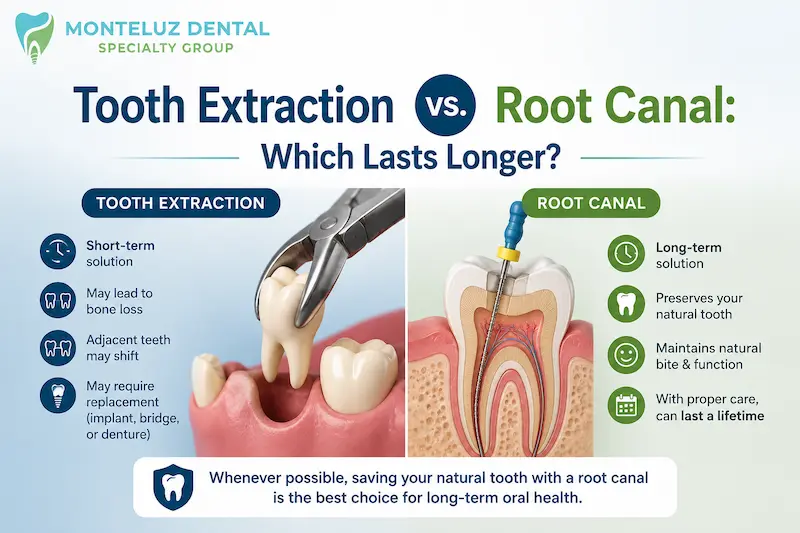
"The primary goal of a root canal isn't just to stop the pain, but to preserve the integrity of your natural smile. Replacing a missing tooth is always more complex and costly than saving a natural one through endodontic care."
Step 4: Cleaning and Shaping the Canals
This is arguably the most critical part of the process. Once the pulp is removed, the dentist cleans the pulp chamber and root canals. Because root canals are very narrow and often curved, this requires a steady hand and specialized files.
The dentist will:
- Clean out all bacteria and debris.
- Shape the canals to ensure they can be filled properly.
- Use antimicrobial solutions to flush out the canals and kill any remaining bacteria.
Depending on the severity of the infection, the dentist may place a temporary medication inside the tooth and wait a week before sealing it to ensure the infection is completely cleared.
Step 5: Filling the Canals
Once the canals are thoroughly cleaned and dried, they are filled with a biocompatible material, usually a rubber-like substance called gutta-percha. This material is placed with an adhesive cement to ensure the canals are completely sealed against future bacterial invasion.
If the tooth lacks enough structure to hold a restoration in place, a small metal or plastic post may be inserted into one of the canals for added support.
Step 6: The Final Restoration
A tooth that has undergone a root canal is more "brittle" than a healthy tooth because it no longer has a blood supply. To protect the tooth from fracturing and to restore its full function, a permanent restoration is required.
In most cases, this means a custom-made crown. At Monteluz, we ensure that your restoration matches the color and shape of your natural teeth perfectly. While the root canal cleans the inside, the crown protects the outside, allowing you to bite and chew normally again.
Recovery and Aftercare
Most patients return to their normal activities the very next day. While the local anesthetic wears off, you may experience some mild soreness or "throbbing" in the area for a few days, which is usually manageable with over-the-counter pain relievers.
To ensure a smooth recovery:
- Avoid chewing on the treated tooth until the final crown is placed.
- Continue brushing and flossing normally to keep the area clean.
- Follow any specific antibiotic instructions provided by your dentist.
- If you experience severe pain or swelling that lasts more than a few days, contact your dental office immediately.
Why Choose Monteluz for Your Root Canal?
Choosing the right provider is essential for a successful outcome. At Monteluz Dental Specialty Group, we pride ourselves on being a bilingual practice that caters to the diverse community of San Bernardino. We understand that dental care can be a financial concern, which is why we accept most major insurance plans and Medi-Cal (Denti-Cal), and offer flexible financing options to fit your budget.
Our specialists use the latest technology to ensure your treatment is efficient, precise, and—most importantly—pain-free. We are committed to saving your natural teeth and restoring your oral health in a warm, welcoming environment.
If you are experiencing tooth pain, sensitivity to heat and cold, or swelling around your gums, don't wait for the problem to worsen. We invite you to schedule a free consultation at Monteluz Dental Specialty Group to discuss your symptoms and learn how we can help. Our friendly staff is ready to answer your questions in English or Spanish and help you get back to a pain-free life. Contact us today to request your appointment!